Showing posts with label Kansai. Show all posts

Thursday, August 8, 2024

Returning to Kansai


View from Umeda Sky Garden (with the Gate Tower Building in the background!)


After quite a few long years away, I just came back from my first trip to West Japan in about six years. This was the first time I'd been to the Kansai Region in a long time, and my first time there with family. My fam didn't come visit me for the years I was living in Osaka - my mom is the very definition of a nervous traveller. It took a lot of convincing to finally get her to go, but now that both of my parents are retired, we'd been urging them to travel while they were still relatively healthy. And so, I planned and executed as perfect a 2-week Japan vacation as I could manage, starting in Osaka, of course.


It was so satisfying showing them all the things I love about the Kansai area. I was a little selfish in cutting Tokyo time SO short that they barely saw any of it at all (1 day in Atami, 3 days in Tokyo), but there's so much to see and do just in Osaka and Kyoto alone (never mind all the great places I would have loved to take them in Nara, Wakayama, Shiga, Kobe, et al) that even the week and a half spent there wasn't enough.


Not much had changed, in the places we went, except of course for the extreme number of tourists. On one level, I hate contributing to the overtourism problem. We skipped most places like Kinkakuji, Gion and Kyomizudera that would have been staples to take guests to ten years ago, in the pre-Instagram world. I tried to go off the beaten path when I could. When I saw the chaos of people at Fushimi Inari (when I lived there, there was never any significant number of people on the hiking trails, no matter what time of day we visited), I had tried to prepare myself for the fact that it had become one of the #1 destinations in Kyoto, but it was still mind-boggling to see. The days of using Fushimi Inari's trails as a way to get your daily exercise in (yes, I tried this in 2008 or so, since Keihan Fushimi was just a hop, skip and a jump away from my home station) are long gone. I did get up at 7 AM and hit the trail for old time's sake, and I mostly avoided the crowds, but I had to turn back at the pond, since we were due to move on to our next destination that morning. On that same day, I encountered my first extreme shinkansen delay - the eastbound Tokaido was 30 minutes late leaving Kyoto. Couldn't believe that happened on the day of my parents' very first and only shinkansen trip.


I have a lot to say about the trip, but not enough space to say it all in one post, so I'll divide it into a few entries. I hope you'll enjoy them.

Thursday, November 29, 2012

Tower of the Sun


Prose

They said I would have my own empire to stand over, and it was true; for no one stood closer to the sun than I.

When I came to life, my kingdom was but a crater in the earth. Metal, sand and plastic stretched as far as my eyes could see, but I sensed that gleaming potential in every direction. My eyes, looking hungrily future-ward, already knew the world as it would be.

And it would be glorious.

Back then, I gazed upon parkland and the beginnings of the wheel; when they placed the Golden Mask upon my face, it was then I came to have Suita within my sights. Suita was ahead, and Festival Plaza, behind. I would see everything that was, and everything that would be.

I saw it all, my kingdom, my subjects, from there on my knoll. 

When you anticipate how your short life will end, or how it will begin to end, the most magnificent sense of perspective becomes yours. The years between my birth and the day they prised the Tree of Life from my body were no more than a moment for me – and with that my empire too began to disappear, bit by bit. Soon my protection was all but gone, along with everything else. I stood alone.

My faces, though, kept staring in all three directions – past, present, and future. I never wavered from my task, even when the lights of my eyes went out completely. Even when my kingdom – for so long that pinnacle of the ‘future’ – was razed to the ground. I could descry my own end as sharply and clearly as I understood that the future I represented would never materialize. The dream had long ended.

Ah – but was it so bad? After all, only I was blessed – or cursed – with the knowledge. No one but I could see the whole of Osaka in quite this way. And though others came who dwarfed me in stature, it was still I who would be ever nearest to the sun.


Saturday, October 20, 2012

From Demachiyanagi | 出町柳から


On the topic of the Okeihan change over - I just found out that the Keihan Line actually has its own image song. That's so fantastic!

This track, released in 2003, is called "From Demachiyanagi."

I can't get over these lyrics! Maybe I'll translate them for a study project sometime?

出町柳(でまちやなぎ)から 電車は走る
ああ2人を乗せて 愛の2階だて
ダブルデッカー (そうでっかー)

三条から乗客が ふえだします
四条からは 買い物帰り
おしゃれな人々
七条やがて地上へ そして丹波橋
中書島(ちゅうしょじま)から 補助席が使えます
夕日をあびた酒蔵(さかぐら)の街
まるで影絵のよう
左には競馬場
まるでどこかのフリーウェイ
まもなく車掌もくる

(セリフ)ご用の方はこざいませんでしょうか

出町柳(でまちやなぎ)から 電車は走る
ああ2人を乗せて 愛の2階だて
出町柳(でまちやなぎ)から 電車は走る
ああ2人を乗せて 愛の2階だて
轉載來自魔鏡歌詞網
ダブルデッカー (そうでっかー)

この電車は 京橋までとまりません
枚方(ひらかた)市には
平日朝ラッシュ時の
淀屋橋行きのみ停車です
テレビカーなら
着くまでテレビが見れます
そのうちに京橋の街のあかり

天満橋(てんまばし)からまた地下へもぐります
次は北浜 そして終点は淀屋橋
淀屋橋が終点

(セリフ)ご乗車ありがとうございます

出町柳(でまちやなぎ)から 電車は走る
ああ2人を乗せて 愛の2階だて
出町柳(でまちやなぎ)から 電車は走る
ああ2人を乗せて 愛の2階だて
ダブルデッカー (そうでっかー)

Sunday, October 14, 2012

Keihan-chan

Keihan-chan (Keiko Morishoji) showcasing the goods of Higashiyama

In a PiTaPa ad
In 2000, the Keihan train line launched an advertising campaign called おかいはん (okeihan) to promote themselves using young, fashionable spokeswomen photographed around the Osaka-Kyoto area, seeing the sights and culture available in towns and cities along the train line. This campaign was still running when I lived in Osaka, and the current Okeihan girl was Keiko Morishoji (the idea being that she lived near Morishoji Station!), the third-generation Okeihan character, who started in 2006. Keiko (played by actress Jinno Sachi) was born into a musical family and was a Conservatory of Music student at the "Duck River Academy of Music." She was the face of the campaign until 2009, and I thought she was the cutest thing on this earth. Her clothes were bright, stylish and just the sort of things I liked to wear, and she was always doing something that looked interesting to me. I started to take photos of her ads when I saw them, and downloaded a bunch of Okeihan desktop wallpapers.


Emily often teased me about my enthusiasm for Keiko, whom I called "Keihan-chan," not knowing her name at the time. We travelled on that line pretty much daily, and often together, so whenever a new poster came out (and that was fairly frequently!) I was all over it. I professed my love for Keihan-chan every time I guided someone new through the Keihan train system. And then...then, they retired my Keihan-chan and replaced her with a new girl, Keiko Kuzuha!

Kuzuha was cute enough, but I never expected Keihan-chan to vanish so suddenly, so I was quite disappointed. At the time, I didn't realize that there were two other Okeihan spokesgirls prior to my arrival in Japan - Keiko Yodoya and Keiko Kyobashi. Well. 

As it turns out, the Keihan line is launching their newest girl to stardom very shortly - voting starts this Monday, October 15th, for the brand-new Okeihan campaign.

Yodoya, Kyobashi, Morishoji (♥) and Kuzuha

Well! I guess it's my civic duty, then, if we MUST have a new Keihan-chan, to make sure the proper one gets picked! Be sure to pop by Keihan's website tomorrow and cast a vote!

Thursday, September 27, 2012

Photo of the Day - Dotonbori 1970

Swinging in the rain, Japan’s “now” generation invades Dotombori, a street in downtown Osaka lined with restaurants and places of amusement. The five-petaled cherry blossom emblem of Expo ‘70 competes for attention with a gaudy welter of neon signs flashing traditional characters. 
National Geographic, March 1970

Saturday, September 8, 2012

Photo of the Day - Shinsekai By Night

Note: I don't really recommend going to Shinsekai on your own at night. But it's cool to look at from a distance!

Saturday, August 18, 2012

The Humid Japanese Summer

The Pepsi NEX summer life
Here in Toronto, our heat wave has finally broken, or so my roommate tells me - my response was "what heat wave?" The weather in Toronto, hanging around 30 degrees Celsius (86°F) has never really bothered me, compared to Osaka, which boasts some of the most humid days and nights in the country.

I often really miss summer in Japan. It's true, it was muggy, sticky and came part and parcel with all the bad stuff - I remember when all the maple candy omiyage I had brought from Canada fused into a giant mass, and ruining my first rice cooker by forgetting to clean it out before I left town during the hottest part of the summer. One year, I had kept some chocolate matcha Meltykisses from winter that, well, melted. As much fun as it was to go to festivals, I found yukata really stifling on the hottest summer nights, and distinctly remember undressing in a stall in JR Kyoto Station during Gion Matsuri just to get some of the heat off, before re-tying everything and slogging back out there. It wasn't great, but I detest the cold, so I quickly warmed up (ha ha) to the hot and humid summers and even began to enjoy them.

After Osaka, summers in Canada have been easy as pie. While my friends (raised on the east coast where both summers and winters are mild) suffer through humidity that's completely undetectable to me, I relish actually getting to wear short sleeves. 

In Japan I spent a lot of my summer days in the staff room at school, conserving my precious nenkyu (paid vacation days) for the visits of the many friends who stayed with me. I often worked through obon as the only person in the school! Thinking back to that, someone must have unlocked the gate every day, but it was rare to encounter even a single person through the whole 8 hours. I would let myself into the office and take the keys to the staff room, then sit at my desk near the window and write or read. No students, no teachers. It was somewhat eerie, but at the same time, very peaceful. 

The staff room had no air conditioner, but the fan was right behind my desk to provide some relief. Sometimes I'd go down to the womens' lounge and sit there awhile on the warm tatami. Tried not to do that too much, as it was very easy to fall asleep! I just became quite comfortable with the temperature in the school in summer - it reminded me of many summers spent at camp in New Brunswick. When I wasn't at school during summer, I travelled - to Tokyo, mostly, and once to Los Angeles. I traded the humid heat for dry heat, and didn't really care for the switch. Returning to Tokyo was a relief!

Of course, my love of the heat made winters all the worse - doubly worse after returning to Canada! Can't say I'm much looking forward to the temperatures starting to drop over the next few months...

Tuesday, August 7, 2012

Photo of the Day - Fire Alarm

Dotonbori Hotel, Osaka
Dotonbori Hotel, Osaka.
That's how small these rooms were!

Wednesday, August 1, 2012

Automatic Takoyaki Maker

I cannot believe this is a real thing!

Takoyaki, Osaka's Speciality Food
Perfectly cooked!

If you remember my post from a few weeks ago about my undying love for takoyaki, you'll likely remember that I mentioned making it from scratch can be a little tedious, unless you have the patience to sit and watch the grill and turn each takoyaki on time. (This is likely why most people have takoyaki parties, so that they can enjoy themselves  together and divide up the work!) 

However, a website called JapanTrendShop apparently sells automatically rotating grills to help you with the difficult parts! The Takoyaki Factory Ton Ton has a motor that flips the takoyaki over as it cooks to make perfectly-shaped balls at home. A little expensive, but the kit even includes a long-stemmed pot for easy batter pouring, the special brush to oil the grill, and the skewers. If I did not already have the electric takoyaki grill I brought home from Japan, I would be all over this!

Monday, July 16, 2012

Okonomi House

Okonomiyaki topped with bonito and aonori at Okonomi House in Toronto. Great Japanese food!
Osaka-style okonomiyaki at Okonomi House in Toronto!

I briefly mentioned Okonomi House last week in my post about Tokyo Grill's hiyashi chuka, but I didn't imagine I'd have a chance to get out there and take photographs for a proper review anytime soon. Somehow, though, whenever I get within three blocks of Bay and Charles, the craving for okonomiyaki grows too strong to resist!

Okonomi House entrance in Toronto. Great Japanese food!
Entrance - the sign to the left, of
course, reads okonomiyaki!
Okonomiyaki, for those unfamiliar, is a speciality dish that both Osaka and Hiroshima lay claim to. Okonomi House serves the Osakan version - a savoury pancake filled with shredded cabbage; grilled and topped with a Worcestershire-like sauce and a dot of mayonnaise. In Japan, the mayo - Kewpie mayo, of course - is often laid out in stripes and then topped with shaved bonito and aonori, seaweed flakes. 

This may sound like a lot to handle for those inexperienced with the Japanese palette (says my roommate: "I hate cabbage!" yet she loves okonomiyaki!), but I've actually found this dish to be a fabulous gateway to the land of non-sushi Japanese food. It's most often described as a "Japanese pancake" or "Japanese pizza" - neither of these are even close to accurate - and is one of the two 'safe' foods I've introduced to friends and family that everyone has liked. (The other being tonkatsu.) Even though it contains cabbage and has fish flakes and mayonnaise on top, which are all warning signs, the combination always works out - many times, I depended on that little mom and pop shop next to my apartment to start off someone's visit to Osaka with some real okonomiyaki or takoyaki.
Okonomi House'sOkonomiyaki in Toronto
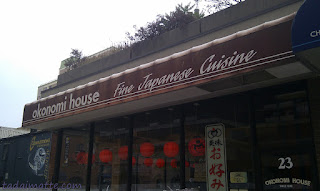
Okonomi House - Fine Japanese Cuisine
Toronto's Okonomi House is not exactly next door, and it isn't quite that same fluffy, airy style that I came to expect in Osaka, but it's the closest one could ever hope to get without actually hopping on a flight to KIX. The restaurant has been a fixture at Bay and Charles since 1978, and it's not hard to see why - every time I go there, day or night, the place always has customers. I love the 70s decor, and the fact that even though you don't cook the okonomiyaki yourself (a popular choice at Osaka restaurants), you can still watch it being made through the glass wall by sitting at the bar. The interior of this place is not so different from the izakayas I used to visit with JET friends, and the iconic chochin lanterns are very like the ones that hang outside of restaurants in Japan.

The food, of course, is fabulous. While the other dishes as all right, if a little on the Westernized side (teriyaki and yakisoba, and I still haven't found anyplace in Toronto to get the perfect yakisoba), it's the okonomiyaki that is the superstar here. I've tried a few versions, but I keep coming back to the pork okonomiyaki, which is considered the 'standard' type in Japan. I cannot say I recommend the chicken - the texture and way it is cut just doesn't lend itself well to this style of dish. Thin strips of pork or beef, though, nice and browned on the edges, are perfect. The scallop version is supposed to be very popular as well. 

Okonomi House's cute chochin, paper lanterns. Great Japanese food in Toronto!
Okonomi House's cute chochin, paper lanterns
You can tell that Okonomi House has adapted its own style over the years, whether to better suit the clientele of Toronto or the owner's preference, so it's sometimes a not quite what former expats or Japanese nationals living in Canada would expect. The first time I ordered, I was shocked to see that the bonito and aonori were extras that you had to request, but Canadian diners might have initially shied away from them. The size of the portions are also smaller than standard, and it's almost certain that I will leave a little bit hungry - or eat half of my dining companion's entrée. An exchange student friend was aghast to see the heavy irons used to press the pancakes into dense discs - in the town where she grew up, she had never eaten an okonomiyaki that wasn't fuwa-fuwa; 'fluffy,' and the outside of Okonomi House's okonomiyaki are also softer and less crunchy than she was used to. I heard somewhere that this technique is more common in southwestern Japan, as well as the placement of the mayo in a dollop in the centre of the pancake, unlike the usual striping you'd find in Osaka. Chicken wasn't something either of us ever saw in Japan, either, but the whole design is supposed to be 'as you like it'! If Canadians like chicken in their okonomiyaki and would prefer to skip the extras, so be it. It may not be 100% perfect and authentic, but I'd wager a guess that the cook probably knows his clientele better than I do.

Myself, I'd be thrilled to see a mochi-and-cheese option, and maybe a modan-yaki; a popular variant made with yakisoba noodles on the bottom - but I doubt the menu here is changing anytime soon, and we certainly don't want to risk the prices going up! Okonomi House is the best deal in town when it comes to Japanese food; my usual lunch of a pork okonomiyaki with aonori and bonito, with a cup of green tea (sadly, the teabag version), is well under $10. It's also a place I don't feel uncomfortable coming to alone when I need to, which is always a plus for a downtown core restaurant, and they offer their food to-go.

Another great thing about Okonomi House is the service. Every time I've gone, the servers have been friendly and super-attentive, checking on you just the right amount. Once or twice, the servers have picked out something in my pronunciation of words and asked if I spoke Japanese, leading to a conversation, which is something I can safely say has never happened dining anywhere else in Toronto and always makes me happy. The friendly atmosphere is (well, besides the okonomiyaki!) is what keeps me coming back every time!
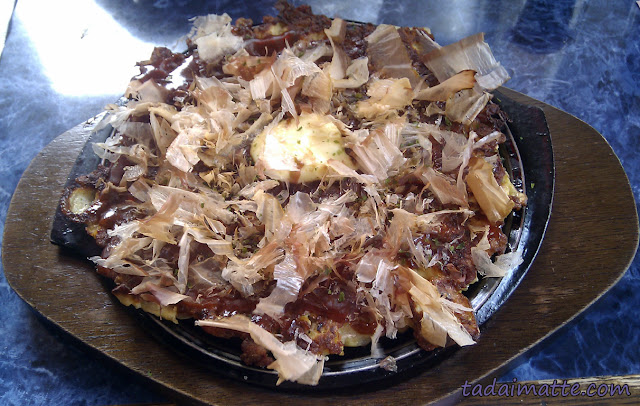
Okonomiyaki topped with bonito and aonori at Okonomi House in Toronto. Great Japanese food!
Yum!

Wednesday, July 11, 2012

The Takarazuka Revue; A Woman's World

If you've never heard of the Takarazuka Revue, let me open up this post with an image:

Tsuki-gumi's newest production, Romeo & Juliet(te), opens on August 10

These two are Manaki Reika and Ryuu Masaki, popular stars in the world of the Takarazuka theatre. Ryuu/Romeo is an otokoyaku - that is, a woman who exclusively plays male roles within the troupe. Takarazuka's biggest draw is that it's for women, by women, even if the women are pretending to be men - and most of them pretend very well! 

Star Troupe's Aran Kei as Percy Blakeney
in The Scarlet Pimpernel, 2008
The Revue was formed by Ichizo Kobayashi, then-President of Hankyu Railways, a private railroad well-known in Kansai. The city of Takarazuka in Hyogo Prefecture, popular for its hot springs, was at the time the terminus of Hankyu's train line from Osaka City. In 1914 he created the Takarazuka Revue to be a further tourist draw for the area, and designed it to be all-female, based on the way that kabuki was traditionally performed entirely by men. It wasn't long before the musicals and their finales with showgirl-costumes, sparkles and glitter charmed the women who flocked to see the shows. The Takarazuka Grand Theatre was built a decade later.

Since then, the Revue has performed hundreds of shows both original and adapted from Western musicals and Eastern classics, and has a second theatre in Tokyo. There are five troupes within the Revue that each have their own style and way of performing, and marquee showtime is rotated between them to ensure that each troupe has plenty of time to prepare their latest feature. The five are called Hana (Flower), Tsuki (Moon), Hoshi (Star), Yuki (Snow) and Sora (Cosmos). Each troupe is also associated with certain characteristics, such as Soa being the 'experimental' group as the newest of the five, Yuki is heavily operatic, Hana produces the top otokoyaku stars, and so on.

Becoming a Takarasienne is tough. Training is competitive and starts at high school age. No more than 50 applicants each year are accepted to the Academy. Otokoyaku training is even tougher work, as they are expected to dress, behave and speak in a masculine form from their second year of schooling. They work on deepening their voices to sing and speak in a more masculine tone, and carry themselves as refined men would.

Takarazuka Grand Theatre in Takarazuka City
Image courtesy of Wikimedia Commons

The Takarazuka audience is said to be about 90% female, and looking at the real thing, I would have estimated the numbers to be even higher than that. While in Japan I saw multiple performances, including The Scarlet Pimpernel, Love and Death in Arabia / Red Hot Sea, Phoenix Wright, The Legend of the Great King and Four Gods and The Rose of Versailles -André- / Exciter!  I was very excited to see Elizabeth, but they were very much sold out for the times we could go. 

Gyakuten Saiban (Phoenix Wright)
performed at Bow Hall in Tokyo by Sora-gumi
I was drawn to Takarazuka when I heard they had performed The Rose of Versailles, a manga I particularly liked in my university days. Tezuka Osamu also drew inspiration from the Revue for his classic Princess Knight, which I'd read at the language orientation in Osaka and is often credited as the very first manga written for girls. (Tezuka was raised in Takarazuka City and one of its other big draws is the Tezuka Museum - more on that in another post.) Luckily, Emily's host mother during her study abroad had been a fan and taken her a few times, and Laura and Marisa were also Takurazuka companions. One of my co-workers, Tanaka-sensei, was a huge fan and we went to see a Rose of Versailles side story together. I was so fortunate to have gotten to see so many shows - living in the Kansai area really does give you access to everything!

Friday, June 8, 2012

Anime and Manga

Dragonball Z Kuririn Birthday Cake
Don't really have many photos of anime-ish stuff in Japan, but here's an amazing birthday
cake with a Dragon Ball character on it that Emily got me for my birthday in 2009. Fantastic.

When I first started taking Japanese classes, I'll admit that it was interest in anime that got me there, and not the other way around. From junior high school on, I was a devout fan of the Japanese animated shows that were on television here in Canada, starting with Astro Boy and progressing to Sailor Moon, Samurai Pizza Cats, The Wizard of Oz, Dragon Ball and others. It was after I started going to the local anime society in 10th grade that I got really interested in watching shows in their native Japanese, with English subtitles.

I did a fair amount of growing up between then and when I left for Japan; I had begun to move on to other things by the time I graduated, as I had so many hobbies that I rarely had time watch anime. (I still read manga, when I can afford it.) Fans, I'm sure, would probably consider it an incredible waste that I went to Japan after this had happened!

I clearly remember a conversation I had with my vice-principal and my go-between in the car as we left Osaka Orientation, and they asked if I liked manga. This was the first time I had met either of them and I wanted to make a good impression; didn't want to look like what some JETs referred to as an "akiba-boy/akiba-girl," someone who only came to Japan for the chance to go to Akihabara and buy toys. At the same time, I couldn't exactly lie, so I replied "sometimes," and they asked what series I liked.

Scrambling for one that wasn't too associated with 12-year-olds, I replied that I liked Hikaru no Go (a series I hadn't read in many years), and then had to field questions for the next five minutes on the plot of Hikaru no Go and whether I could play Go and so on. Oops.

Tezuka Osamu Mittsume ga Tooru
Mittsume ga Tooru figure.
Tezuka Osamu, creator of this series as well as classics
like Astro Boy, is said to be "the father of manga."

Still, when I was there, the mere exposure to so much animated goodness had me back into it on a smaller scale. This is mostly thanks to the SkyPerfect satellite service - on my first month in Osaka, all the JETs did a weekend of seminars at a local language institute to help speed us along on our journey to Daily Life In Japan. We had a fair amount of down-time and I hadn't made any close friends yet, so I spent a lot of it in my room watching TV. There were two channels that showed a ton of nostalgic shows that I hadn't seen in years - Pocket Monsters (the original version of Pokemon), Ranma 1/2, Dragon Ball Z and the like. The channels were Animax and Kids' Station, and they showed anime both new and old, 24/7. I decided then and there that I was buying a satellite dish. Soon, SkyPerfect TV was streaming gems to me like Maison Ikkoku, Cat's Eye, Minky Momo, KochiKame, Touch, Nodame Cantobile, Sailor Moon, Kaiketsu Zorori, Dokonjō Gaeru, Detective Conan and Lupin III.

For a long time, I was so relieved to hear "easy" Japanese that I understood, I left the television on 24/7, hoping it would sink into me by osmosis.

This phase passed, and soon I was probably paying way more for my satellite service than was worth it for the amount of TV watching I was doing. The honeymoon phase of struggling through manga in Japanese was also over, but it was nice having the option. On a lazy rainy day, it was good to just be able to turn on the television and know that there was probably something on worth watching - even if that something was marketed at 12-year-olds.

Wednesday, May 23, 2012

Smartphones

When I left Canada, nobody had a smartphone. The very first iPhone had launched the month before, and as this was a time before the App Store existed, only the most cutting-edge of the Apple fans and Blackberry deserters actually owned one. Myself, I only had a Samsung A660 that I was very proud could play Kefka's Theme from Final Fantasy VI when it sensed someone I didn't like coming in on my Caller ID.

Japanese cell phone
The Softbank 812SH in its natural habitat

On my first full day in Osaka, I bought a Softbank 812SH from Yodobashi Camera in Umeda. As an upgrade to my Samsung, it was dynamite. It could smoothly and quickly browse the extensive Japanese Mobile Web, had adorable emoticons, was quite slim and had a big colour screen twice the size of the one I was leaving behind. I sang the praises of Japanese phones to anyone who would listen. Sure, some of my students had televisions on their phones - I was content with just having mobile web. By the time I left Japan, two of my students had iPhones (this was a really big deal, especially for the girl who had the "first" iPhone in the school - 2009!) but the rest used the good old flip style.

When I landed back in the West, I thought I had walked from 2007 right into 2017. Almost everyone I knew had a smartphone - my brother had gone through two of them. It was going to be tough to cope with not being able to efficiently email from my cell (Japan uses email based messaging, not SMS, so in order to send a text message you must send to and from a phone email, not a phone number) so I decided to jump on that bandwagon. Now I own a HTC Desire, and grumble to myself at least weekly about how fantastic it would have been to have had a smartphone in Japan. Yes, I got along just fine without, but I would have been on any of these apps (linked to the Android versions for you, but there are Apple and other equivalents for most!) in a heartbeat:


Photo courtesy of the Google Play Store Photo courtesy of the Google Play Store Photo courtesy of the Google Play Store Photo courtesy of the Google Play Store Photo courtesy of the Google Play Store


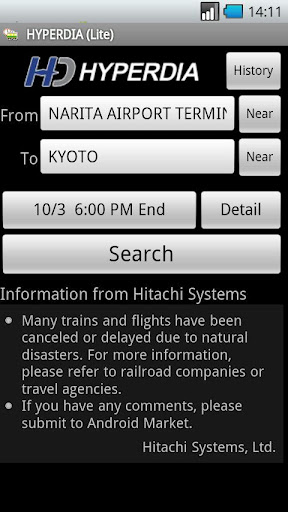
HYPERDIA(Lite) JapanRailSearch - Train schedules. I used the mobile web version on my Japanese phone. I cannot stress how many times I would have been (a) stranded somewhere or (b) lost, if I didn't have Hyperdia. So efficient.

Twitter - Likewise, used the mobile version. I loved being able to microblog about something, then go back and research it later on my computer. Tweets are short, too, so I was comfortable tweeting in Japanese and reading what my Japanese friends were posting なう.

Path or Foursquare -  I really liked Gowalla and it seemed like it had big support among Japanese users, but it was eaten up by Facebook. A check-in service would have been my number-one want in Japan. In a new country, everything is a big deal and it's tough to remember later all the things you saw and did, and tougher still to share them with friends back home. How cool would it have been to have been able to post a check-in from Tokyo Tower?

Instagram - I'm on the bandwagon now. This photo-sharing social media site would have been perfect for visiting temples, shrines, statues, skylines, anything!

WWWJDIC For Android - This is THE app for anyone struggling with Japanese. Can't read what's in front of you? Draw it into your phone and WWWJDIC will give you a translation.

Saora's JLPT Practice - Studying your Japanese while abroad? I hope so! This app is a great study tool that keeps you on pace for the Japanese Language Proficiency Test.

Kanji Draw 29% - There are a few kanji-drawing apps out there, but this is my favourite. Good interface and customization, and the app really makes sure you didn't just fluke into the right stroke order!

Google Translate - Straight up. Google's translate tools are very effective.

Barcode Scanner - QR codes are super popular in Japan and you can find them pretty much everywhere!

Japanese Traffic - I never drove, but this could be pretty indispensable to someone who did. The app real time traffic conditions in Japan, in Japanese and English.

Japanese Hot Spring Heaven - Searchable directory of over 4000 hot springs. Don't even care that there's no English version - I would manage.

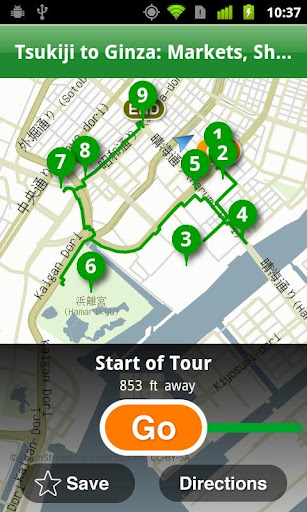
Tokyo City Guide - By TripAdvisor. Tokyo Art Beat also has great reviews! There are tons and tons of city guide apps out there that would have been much easier to work with on those weekend trips than carrying a book would have been. Check out GoodLuckTripKANSAI for the Kansai area, or search the Internet for your destination!

Tokyo Emergency - Can't vouch for how well it works, but this guide has emergency numbers for if you're travelling in the Tokyo area, including consulate and embassy info. And I lost my passport in Tokyo once, so thumbs up for carrying this sort of helpful info around!

As they say...."there's an app for that." If you are visiting or living in Japan, and you have a smartphone, don't let it go to waste!