Showing posts with label Travel. Show all posts

Tuesday, May 25, 2021

Edokko

 Yikes, it's been a while! I'm so sorry not to have much to share these last few months - or rather, I have tons, but have been so caught up I haven't written any of it!

Last Monday, my second novel launched in paperback and as a Kindle Unlimited exclusive.

I began working on Edokko when I was newly back in Canada and truly felt the sting of leaving Japan behind. It's a joy to see it finally in print, and the publishing process brought me back to those early days (don't miss the cameo of the Japan Foundation's Japanese-Language Institute Kansai, where incoming Osaka JETs gathered for language lessons when we first arrived!) and the ups and downs of expat life. I still miss it very much.

Edokko YA contemporary novel by Loren Greene
Available now in paperback and ebook format


Lily Jennings is Going. To. Japan.

Sixteen and on top of the world, she's beyond excited to be setting off for an entire year as an exchange student in Tokyo. Fashion and fun are foremost on her mind as she arrives ready to meet her new host family and embark on a grand adventure, livestreaming all the way.

What Lily isn't expecting, however, is for her urban host family to cancel at the last moment and leave her hanging with nowhere to live. She's shipped off to the small town of Ajimu (sorry, where!?), a billion miles from anywhere cool and exciting, with a neurotic host sister, no chances for romance, straight-up-vile classmates and a microscopic community watching over her every move.

Too bad for the people of this small town—nothing's going to hold Lily back when she wants something!

Find it on Amazon or your favourite retailer via http://edokko.lorengreene.com!

Wednesday, June 1, 2016

TOKYO CITY 憶えているかい ホームの片隅で

So I've been fairly busy with a lot of things lately, and while I tried (and will continue) to keep work-related things off the blog, I thought I'd check in and note that I recently finished my job in one local Japan-related field and moved to another. I'm sad to have left my office and the great people there, but my contract was ending, and an opportunity came up that I couldn't refuse. So what this does mean for me...?

Well...!
As it turns out, it means a lot of travel to Japan.

I'm so excited to have already been back to Tokyo (and eventually I want to take a vacation to my true second home Osaka, of course) and the first visit was really and truly surreal. Maybe it sounds really silly, but I think anyone who has had their heart in two countries at once can relate. It's not about Japan itself but the feeling of being immersed again in a place that was once "home" that I missed very much. 

I took the train from Narita out to Azabu-Juuban, and on the long ride, it was hard to do anything but wax nostalgic! It was early, but even on a Saturday at 8 AM, students in uniforms were taking up most of the train car. On their way to their club practices, I'd imagine. One high school-aged boy sat beside me and I immediately recognized his cologne or body spray as a familiar scent from my own classroom at 〇〇 High School. I'd never been on that train line before or seen that scenery, but just being there on that train, sitting with the Saturday shoppers and the schoolkids and breathing the air and seeing the signs fly past the window, I was feeling so natsukashii. 

I wasn't meeting my friend until 9:30, so I strolled through Azabu-Juuban for a time, a little wowed from how it had changed since I last visited, with Ami-chan years before. Ichinohashi Park was completely gone, and a construction site was in its place. Azabu-Juuban's main station entrace, outside the Shotengai, had also been spruced up a bit. Funny, but I never visited Azabu again after taking Ami-chan there, even when I had lots of time to kill in Tokyo in the past. I guess I felt that as a pop-culture location, most of the places I would have liked to see had already been gone for years by the time I moved to Japan. 

It was really nice walking through there though, and after a stunning only-in-Japan Cantaloupe Melon and Cream Frappuccino at Starbucks and a melon pan run, I eventually ended up in Roppongi Hills to meet my friend. We saw the Sailor Moon exhibition and had lunch at CoCo Ichiban, which I really still don't have the recipe nailed down for yet. Then we were out of time, and I had to head to work.

I was trying to pretend that this was a normal Tokyo trip like the many ones I'd taken before, but as on the visit to Japan a year ago, I couldn't shake the sense of "limited-time" urgency. I probably never will be able to manage that totally, given that when you're on a company trip, the clock is ticking. On the bright side, the next trip is already in the calendar.

See you soon.

Thursday, October 29, 2015

The Young and the Chariotless

When I landed back on Canadian soil in August of 2010, the first thing I did was purchase a bicycle. Having a new bike right away, I hoped, would take away the sting of leaving behind my mama-chari in Osaka, at the very last minute, as I hastily dropped the keys with a Post-It note on my co-worker's desk on the final day. I needed the bike right up until that day, and I didn't have time to deal with boxing it up for transport across the Pacific. I thought that at least if I left it at school, it would be used by someone, and perhaps someday I would see it again. I took the second key home with me, just in case.

The first week home, I bought a cheap Wal-Mart bicycle. I needed to get to work, and I'd become accustomed to the independence of travelling by bike. I also bought a helmet, because unlike in Japan, I was significantly more concerned about being hit by a car. It was a Raleigh five-speed cruiser, and not an expensive one; it did have a partial chain guard, which was the main thing I was missing about my mama-chari at the time, as I remembered ripping up a few pairs of jeans on my mountain bike as a youth. It also had the curved handlebars I liked on cruisers. 

I have to assume the Japanese adapted their bicycles from European ones, as they were trading with the Netherlands as early as the 1600s; Japanese bikes bear strong similarities to Dutch ones. The covered chain guard and skirt guard are very uncommon in North America. Fender mudflaps and rear racks occasionally show up on American-made bikes, but are considered standard in Japan, along with the rear wheel lock and ubiquitous front basket. I would have liked to go for a bike with all the trimmings, but I had to settle for what Wal-Mart had in their inventory at the time. In retrospect, I was actually lucky to get a bike that had two out of the six features I wanted. I installed a rear rack and basket myself.

Eventually, as all Wal-Mart bikes are wont to do, my bike began losing steam in its 4th year, and during a particularly rough trip down into the Nordheimer Ravine one autumn, my jacket bounced out of my rear basket and twirled itself around the derailleur, which fortunately did not end in my dying in the ravine. The bike was never particularly good at switching gears again.

Dutch in action at Casa Loma
But we're going off on a tangent now. As I searched for a replacement to my bike (I had taken that cheap Wal-Mart bike with me on the plane to Toronto, wrapped in a tarp - can you believe it?) I decided that it had to be Dutch or nothing. I wanted a skirt guard; I wanted a proper rear rack. I wanted a mama-chari. I walked down Bloor Street taking photos of bikes I liked and jotting down their make and model to Google later. I never walked by a bike without giving it a once-over. To my surprise, the premium to get such luxuries as full chain guards required paying CAD $600+ for the bike. As I looked at bike shop after bike shop, almost buying a Giant-brand Liv Simple, I realized that I would never be able to tick all the boxes affordably. I finally settled for a step-through Beater Bike, with a partial chain, and a rear rack. What I hadn't bargained on was how much less hill-friendly the Beater was going to be compared to my Raleigh, with its fat tires and five speeds. The Beater, gorgeous though it was, was useless on hills, and the tires were the perfect size for getting caught in streetcar tracks. Riding it was exhausting. So I went back to the drawing board, formulating a plan for my trip to Japan in February to just buy a cheap mama-chari, have them box it up right in the shop, walk it to the post office and pay to have it sent home. I figured I'd be out $150 for the bike, $50 for domestic, $100 for the international shipping. Maybe a bit from customs on the other side. That sounded a lot better than the $600-ish I was pricing for Dutch-style bikes with gears in Toronto.

I think you guys already know this is going to go downhill.

I left the job of actually buying one until the last moments of our trip. I looked at bikes at Asahi Cycle in Rinku Town and Tokyo, but I never spotted one close to a post office (an essential for this plan to work). Eventually, when I was on my own in Tokyo with just one day left in the trip, I realized this wasn't going to work. I went on Rakuten and found a seller that did international shipping for Daiwa bikes, and I bought a cute pink Nana+ bike. No need to drag anything to the post office myself! They shipped to Canada!

...except that they only shipped to Canada through their proxy service. I had used Tenso before, but not in a few years, and the hoops they had me jump through just to get the bike shipped anywhere were out of this world. I waited two weeks without seeing my item appear on the "my page" section, even though the domestic shipping said it'd been delivered. I emailed them, and had no response for days. I started to worry that maybe this company was less reputable than I originally thought. I sent a third help request, which got a response at last, and was informed since it was oversized, they hadn't yet connected the purchase to my account, oh, and also it was too oversized to be shipped abroad. It had arrived fully assembled. I learned later that this is the standard for bike shops in Japan. Tenso said they were unable to downsize it for me by removing the pedals/turning the handlebars, as they weren't trained to do so.

From there we began the lengthy process of finding a solution, any solution. Tenso offered to ship it elsewhere in Japan for me, but in order to do that, I had to verify my address in Canada. Mind you, I'd already done that when I bought things through Tenso in the past, but it had to be done again, including scans of my driver's license and the receipt of a postcard at my mailing address in Canada. That's right, I had to wait for a physical postcard to arrive by postal mail at my apartment. Only when they were satisfied that I really did live at my address in Toronto would they allow me to redirect the bike somewhere else, but obviously, not to Toronto! They urged me to let them courier it to a friend.

I don't have tons of friends in Japan whom I'd be comfortable asking for a favour so large as "can you receive this bike in the mail, bring it to a bike shop to take it apart, and put it back in the mail?" and even fewer that I wouldn't mind being laughed at by. (As genuinely fond as I am of my co-workers at 〇〇 High School, and as much as they already knew I was quirky, I prefer not to be remembered as "that one that asked me to ship a bike to her".) In the end, I asked my friend Nicole, of Irish Chocolate fame. She returned to Japan after leaving 〇〇 University and is now an English teacher in Chiba. She saved me from a separate mishap involving buying Mister Donut cups on Yahoo! Auctions, and so I thought she might be able to intervene again. Luckily for me, Nicole agreed, and some time later my bike appeared, fully formed, at her apartment.

Nicole, bless her, bought a bike-sized cardboard box online and wheeled it all down to her local shop, where they took it apart and packed it up. Then she brought it back to her place (how!?!?) and called Japan Post for an at-home pickup. Except...now it didn't fall within Japan Post's size guidelines. The JP Post guys returned to Nicole's apartment two hours later with the box in tow. It was too big! She told me it would have to be done via a commercial shipping company like FedEx. Now we were getting way, way too expensive, and I wasn't sure what to do next. I'd already sunk more money into the box and the domestic shipping to Nicole, and the losses were too big for me to cut now. We decided to Frankenstein the box to make it smaller, since that approach worked for Emily when she sent her kotatsu home, but after some measuring, it literally needed to be half the size. Nicole promised to look up some options when she got home from her vacation in Europe.

I decided to take a different tactic. My roommate, M, made plans to go to Japan for a concert in October. I decided to ask her if she'd check the bike as her second piece of luggage (oversized). She agreed without too much protest, to my relief, and so I asked Nicole to have the bike couriered to Narita Airport instead. Surprise - the luggage shipping company that we usually use for the airport, doesn't accept bikes. Nothing about the size, never mind that it was in a cardboard box and disassembled, they just don't do bicycles. Nicole had to call JAL ABC, because apparently Sagawa thought we were asking them to ship some expensive French racing bike worth $8,000 and not the little steel mama-chari I bought at Daiwa Cycle for under two hundred bucks. Luckily JAL ABC agreed to take it (after warning me about a COD fee) and it was delivered to Narita on the day M was scheduled to return to Canada.

Ah, but it's not over yet! As I gallivanted through Montreal on a rainy Saturday night, just before midnight, my cell phone alarm went off, reminding me that "M Is At The Airport Right Now." And then there's an email in my inbox dated 30 minutes prior, saying "Does your bike have suspension? Because if it does, I can't take it with me." Followed by, "If you don't answer soon, I have to leave." Oh noooooooo--

I emailed back as quickly as my thumbs would function, NO, NO SUSPENSION

ALSO PLEASE DON'T LEAVE

After all, what was the next step if the bike got stranded at the airport? Call ABC and try to convince them to ship it back to Nicole (I really wanted to stop bugging her) or to another friend? Jes kindly agreed to receive it when I sent a desperate-sounding email asking for her address, but I didn't want to face the phone call where I explained that I, an uninvolved third party, wanted to use a foreign credit card to have this package sent not back to the sender or recipient but to someone else altogether. Also, what was Jes going to do when she got it? It was just too big!

Luckily, M hadn't checked in for her flight just yet, and decided to forge ahead. Air Canada, bless them, accepted the box without complaint, and it was successfully on its way to Canada at last. I waited until 2:30 AM for the inevitable email about something going wrong, before finally dropping off to sleep. In the morning I called for an airport van cab, and then I called The Bike Joint down on Harbord Street to arrange assembly, and then I recruited a friend with a car to drive it down there with me. BIKE BIKE BIKE BIKE BIKE.

It wasn't until she arrived in Calgary and they opened the box for inspection that M realized the extent to which I had thrown her under the bus.

I found this note written on the whiteboard when I got home, after M was safely sleeping off the jet lag:


...but at least I have my bike.

Thursday, January 30, 2014

Writing About Tokyo

Commemorating the 1964 Olympics at Jingu Bashi
I don't think I've ever mentioned on Tadaimatte before that I had written a novel - it's true! 

As you might have guessed, story writing is an outlet for me, and in 2008 while living in Osaka, I devoted quite a lot of effort to penning my first book. At the time, I was enamoured with Tokyo, and deeply interested in studying the evolution of popular culture in The Big Mikan. I went to the library in Hikarigaoka and thumbed through photos of the area from the 60s, I penned thoughtful poems about umbrellas and imagined the lives of the people bobbing through Hachiko Square, watched Rockabilly dancers in Yoyogi Park, traced the steps of Shiki and Beat and Neku from The World Ends With You, read vintage Tezuka manga, attended Comiket, visited all the shops Shigesato Itoi recommended in interviews about MOTHER, sat on the bridge at Harajuku, visited Tokyo 1964 Olympic sites, trolled Jimbocho bookstores in hopes of finding the original 1983 English translation of The Rose of Versailles, and generally fell in love with the way the city had been depicted in works of fiction. I used words like hokoten (short for hokousha tengoku) and expected people around me to actually know what they meant.

In reality, Tokyo - particularly the long trip I took alone in 2008 - was a fairly private experience, simply because I didn't know anyone else who got excited over things like Olympic plaques, croquette rolls and showa retro. I spent something like twelve days wandering the city mostly alone, with no plan, eating curry and rice balls and occasionally having only the vaguest idea of where I was going to spend the night (!). I visited Yokohama and Hakone during this memorable vacation, but spent most of it in Shibuya and Odaiba, having real "down time" in Tokyo for the first time.

One post couldn't possibly sum up how I feel about the capital...but I suppose that's why I wrote a book. I sent it around to just a couple of publishers, as it was such a specialized topic that I couldn't imagine a big company picking it up. I've sat on it long enough now, though, that I've begun to think that self-publishing is the way to go - as intimidating as that is!

So, over the next weeks and months, I'll be continuing to work on this project with the help of my good friend Zippo, and maybe soon you'll be able to download the book right here!

*edit*

And now, you can! Whoa! Check out Meet You By Hachiko on Amazon!


Wednesday, October 10, 2012

Tokyo Fare Watch: October

Looks like American Airlines is having a seat sale good enough to make an AA + JAL flight worth Torontonians' while! I got some really good results on Vayama.com for flights leaving Toronto, connecting in the U.S. and arriving at Haneda or Narita. For the current sale, you'd be looking at a departure between October 4th and November 30th, and a return between October 7th and January 31. Not bad for someone looking to travel through the holidays!

Wednesday, August 29, 2012

Capsule Hotels

I've always been comfortable enough in small spaces, so the concept of capsule hotels really intrigued me when I first prepared to move to Japan. I looked up information on the Internet about where I might be able to find capsule hotels around Osaka and Tokyo for my (envisioned) many nights out on the town! As it so happened, I was too much of a cheapskate to stay out overnight often when I could make the last train home, but I did have the chance to try out a few capsules while in Japan.

If you don't know what a capsule hotel is, nothing sums it up quite like a visual:

Capsule hotel in Osaka Japan
Interior of a capsule

A capsule hotel is just a place to lay your head - you're trading space and amenities for the price, which is usually in the $30 USD/CAD range. I often stayed at the above hotel (Capsule Hotel Asahiplaza Shinsaibashi) in Osaka during the nights between the JET Mid-Year Seminar, a training session held over three days more than an hour away from my apartment. The cost of the hotel (¥2,900) was more than worth saving the 3 hours of travel time heading home after a long day and then back to Abiko first thing in the morning - not to mention the ¥600+ yen each way in train fare.

Most capsule hotels do not accept women, and this was one of two that I was aware of in Osaka that did. In fact, I'm told that the womens' floor (sealed off with a lock to prevent intrusion) at Asahiplaza Shinsaibashi was much nicer than the mens', and with less snoring. The beds you see in the photo above are stacked two units high and luggage is kept in a separate locker. In the womens' area, there was a public bath, sauna, television room and reading lounge. Guests are provided with pajamas and towels, and the bathing area has toothbrushes, brushes and combs kept in a sterilizer, hair dryers, lotions, Q-tips, make-up sponges and a few other disposables. Most hotels have a few mainstays built into their capsules - usually a television, radio and alarm clock are standard; the Shinsaibashi hotel also had an interior fan and some shelves. 

Each time I visited, I made sure to take advantage of the beautiful baths at this hotel. I wasn't sure I could manage it for the first time if someone else was in the bathing room, since it was still very early on in my stay and I was nervous at being the only foreigner there. I was alone when I stowed my clothes in the bathing room lockers and managed to almost finish washing my hair before another guest, a lady in her mid-40s, came in and started to shower. She didn't even give me a second look. so after a moment my awkward feeling passed and that was that. 

That first bath was amazing. I hadn't yet experienced Spa World, and this was a whole different beast anyway; it was more of a sento (neighbourhood bath) environment. The shampoo, rinse and soap from the showers smelled gorgeous, too, and after relaxing in the bath (made of black marble) I went to the sauna to dry off. They had everything I needed to make myself comfortable for the night and the nervousness entirely passed. That evening's sleep was very, very comfortable.

Most capsules are really pretty standard, though some, like Kyoto's 9 hours, really take it to the next level. Over the next few years I tried out a few capsule hotels in Tokyo as well, including some off-the-beaten-path choices like the womens'-only VIVI Roppongi one weekend when I had taken the Seishun 18 to Tokyo on a whim and didn't have a single toiletry with me except the contents of my purse. I still regret not taking good photos of that place, since it was really fantastic.

VIVI Roppongi capsule hotel in Tokyo for women
Awful photo of the bunks at the fabulous VIVI Roppongi

It was my first time going to Roppongi, and I was rather disappointed with the area, sadly. VIVI was great, especially the rock sauna, but the next few times I visited Tokyo on a whim back I ended up back in Shibuya instead. I also stayed at the Green Plaza Shinjuku once, but their facilities weren't worth the price in comparison. It just wasn't as nice as my capsule hotel in Osaka or as the capsule beds at Khaosan in Asakusa. 

I still regret not getting to stay in a tatami capsule at Capsule Ryokan Kyoto. Next time, Japan!!

Tuesday, July 24, 2012

Bad Decisions Make Great Stories

Misadventures in Japan
I love this quote! So many of my misadventures in Japan turned into unforgettable stories.
Not that anyone wants to be held accountable for poor decision-making,
but it sometimes makes for the most entertaining tales...

Photo via icanread @ tumblr

Wednesday, July 18, 2012

Conan Town

Detective Conan Town Hokuei Tottori Japan
Not close.

One of my greatest adventures in Japan was visiting Conan Town in 2009. I had never gone so far afield for a day trip before, and I had never taken a daytime highway bus anywhere, either. Nor had I ever come quite so close yet to getting stranded in the middle of nowhere in Japan!

My friend Ami was visiting me from Canada, and she had short list of things she wanted to do in Japan. She asked about Conan Town, also known as Hokuei-cho, a place that I'd been resolving to visit over and over but had never gotten to it due to time and cost. Just to give you an idea of how much time and cost I'm talking:
Hokuei was created from the 2005 merger
of the towns of Hōjō and Daiei Towns

Route1
Take time: 260 Minutes Transfer: 3 Times Distance: 282.5 km

Total:¥ 8,070 (Fare:¥ 5,150 Seat Fee:¥ 2,920) 

Thanks, Hyperdia.

Oh yes, that's one way. Looking at over eight hours combined travel and about $160 in cost (the exchange rate was comparable at the time) if I wanted to slog all the way out to Tottori-ken and see this place. It wasn't something I was willing to undertake alone, and none of the friends who'd been to visit me were up for this expensive and monumental task. I can't blame them - we had some pretty big adventures as it was. Ami, though, is a fan of the manga Detective Conan, and the lure of Hokuei-cho is that it is the birthplace of Aoyama Gosho, the artist of this series. 

When the idea of taking a day trip to Tottori came up with her, she immediately agreed.

If you were spending 11 hours
in train/bus seats in a day,
you'd want to relax a little, too!
I had to find a way to bring down the cost and the travel time. Luckily, my Google skills and my Japanese were just good enough to get us set up on a Nihon Kotsu bus for a very reasonable ¥3,600. I think we left at either 8 or 9 AM, and the bus was just over 3 hours from Hankyu Umeda to Tottori City (which, I should point out, is nowhere near Hokuei-cho).

Our next trick was getting from city to town, which is further into the boondocks of Japan than I had ever been. We got lunch but missed the San-in Line train, which meant buying reserved seats on the charmingly-named Super Hakuto limited express.

About two hours and one long wait for a train change later, we finally disembarked, tired and excited, at Yura Station!

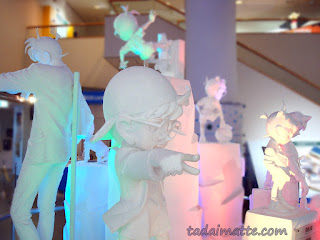
Detective Conan statues were all over town

It had taken us almost seven hours to get this far. This probably should have been indicative of how the rest of the day was about to go. Still, we were happy to be there at last! It had been dreadfully difficult to find information in English on the town in our pre-Google-Translate world - I probably spent 30 minutes just digging out the name of the train station - so we didn't have much idea of what to expect. 

These tablets marked the path from the
train station to the Manga Museum
For those who got this far in the post without any idea what I am talking about when I say Conan, well, Detective Conan is a famous comic series that is among the longest-running in Japan right now. The first volume came out in 1994. The manga has been released in English under the name Case Closed.

The basic premise of the story is that a high school-age genius detective, Kudo Shinichi, witnesses a shady exchange between members of an organized crime syndicate, the Black Organization. He is caught and fed poison, but instead of killing him, the poison shrinks him into a grade-schooler. In order to protect his family and friends, he takes on the name Edogawa Conan and goes undercover, living with his maybe-girlfriend and her PI father while he tries to take down the Black Organization. I hoped to see the conclusion of the series while I was in Japan, but no such luck - it's about to hit the 20-year mark.

The original moulds used for the
statues around town 
Back in Conan Town, being the birthplace of Aoyama Gosho is obviously a huge claim to fame for this little village, though many of the elements of Hokuei-cho were a bit dated - the statues and other permanent landmarks were based on Aoyama's earliest drawing styles; mid-1990s. I had the locations, though, of seven Detective Conan statues in the town, and a list of other spots of interest. 

Walking along the road toward the Manga Museum, the main attraction of the town, tablets lined the pathway, each one showing the cover design of one of the manga volumes. The area's other claim to fame is watermelons, so watermelon motifs were quite popular. (We ended up coming home with Tottori pears, but no watermelons.)

Where the magic happens!

Where the statues were dated, the Museum was very modern. We passed a closed souvenir store that had seemingly moved into the Museum, so it had obviously seen a lot of effort put into it to lure the big fans. There were appearances here and there by Yaiba, the lead character of Aoyama's pre-Conan manga of the same name, and plenty by Kaitou Kid, star of Magic Kaitou and a very familiar crossover character. My favourite feature was the replica of Aoyama Gosho's workdesk. 

Shinichi statue at the library
There was an interactive skateboard game, a voice-changing bow tie, a showcase of Detective Conan in various languages, a selection of famous mystery novels by authors Aoyama enjoys, sculptures, toys, original pages of Aoyama's works, giant cardboard characters...this place was as thorough as any big museum in Tokyo! We spent so long going through the museum and the gift shop that we left ourselves very little time to go see the remaining statues.

Professor Agasa's car
After we finished at the museum and made a quick stop at the bookstore, we were about to head back to the station. Unfortunately, we still hadn't seen that last statue! Glancing at the map and the clock - 5:30 - I had to admit that there wasn't really enough time to go up there and see it, and still make it back for the 5:56 train. It was a Sunday, so there was only one train per hour, and this train was the last one that would get us back to Tottori in time for the bus home. If we missed the bus, I had no Plan B. Stranded six hours from home on a school night? No thanks.

Still....I really wanted to see it. There was only one statue of Ran in the whole town at the time (though now there are two!), and on the map, she did look close by. Daiei Elementary School was behind the train station, so we would be on the wrong side of the tracks, but on our not-to-scale map I thought perhaps it couldn't be more than five minutes from Yura. I asked Ami if she was up to the challenge - from the library to the elementary school and then back to the station, in 25 minutes. Could we do it?

She's asthmatic, so I'm not sure why she agreed to this, but the game was afoot. Away we went!


Don't do this.


Needless to say, when we arrived at the school at 5:42, we were more than a little worried about being stranded in Conan Town overnight. Had it been a Saturday, sure, Conan Town forever! But the best we could do was snap a couple of photos of the statue and then run back to the station before we heard the train warning bells. As it was, we had just enough time to quickly buy tickets ("How much should I put in?" "It doesn't matter! Just get any ticket and we'll fix it later!") before the train arrived and it whisked....er, trundled....us back to Tottori City and the Nihon Kotsu bus.

Mirai e no Ayumi
The statue that almost cost us dearly

From there, it was a long journey back to Osaka - when we were dropped off at the OCAT building at last, we were tired and pretty cranky, and Ami left her bag of Magic Kaitou books in the overhead compartment of the bus. By the time we realized it, we were so exhausted we didn't have the energy to go and file a claim. We arrived back at my place well after midnight, having clocked a full 14 hours in transit. That's quite a feat for a day trip!

Still, it's not a stretch at all for me to say the museum alone made our ridiculous journey worth it, and we had ourselves quite an adventure. I would have done it again in a heartbeat - but I would have given us two days!

Wednesday, July 11, 2012

The Takarazuka Revue; A Woman's World

If you've never heard of the Takarazuka Revue, let me open up this post with an image:

Tsuki-gumi's newest production, Romeo & Juliet(te), opens on August 10

These two are Manaki Reika and Ryuu Masaki, popular stars in the world of the Takarazuka theatre. Ryuu/Romeo is an otokoyaku - that is, a woman who exclusively plays male roles within the troupe. Takarazuka's biggest draw is that it's for women, by women, even if the women are pretending to be men - and most of them pretend very well! 

Star Troupe's Aran Kei as Percy Blakeney
in The Scarlet Pimpernel, 2008
The Revue was formed by Ichizo Kobayashi, then-President of Hankyu Railways, a private railroad well-known in Kansai. The city of Takarazuka in Hyogo Prefecture, popular for its hot springs, was at the time the terminus of Hankyu's train line from Osaka City. In 1914 he created the Takarazuka Revue to be a further tourist draw for the area, and designed it to be all-female, based on the way that kabuki was traditionally performed entirely by men. It wasn't long before the musicals and their finales with showgirl-costumes, sparkles and glitter charmed the women who flocked to see the shows. The Takarazuka Grand Theatre was built a decade later.

Since then, the Revue has performed hundreds of shows both original and adapted from Western musicals and Eastern classics, and has a second theatre in Tokyo. There are five troupes within the Revue that each have their own style and way of performing, and marquee showtime is rotated between them to ensure that each troupe has plenty of time to prepare their latest feature. The five are called Hana (Flower), Tsuki (Moon), Hoshi (Star), Yuki (Snow) and Sora (Cosmos). Each troupe is also associated with certain characteristics, such as Soa being the 'experimental' group as the newest of the five, Yuki is heavily operatic, Hana produces the top otokoyaku stars, and so on.

Becoming a Takarasienne is tough. Training is competitive and starts at high school age. No more than 50 applicants each year are accepted to the Academy. Otokoyaku training is even tougher work, as they are expected to dress, behave and speak in a masculine form from their second year of schooling. They work on deepening their voices to sing and speak in a more masculine tone, and carry themselves as refined men would.

Takarazuka Grand Theatre in Takarazuka City
Image courtesy of Wikimedia Commons

The Takarazuka audience is said to be about 90% female, and looking at the real thing, I would have estimated the numbers to be even higher than that. While in Japan I saw multiple performances, including The Scarlet Pimpernel, Love and Death in Arabia / Red Hot Sea, Phoenix Wright, The Legend of the Great King and Four Gods and The Rose of Versailles -André- / Exciter!  I was very excited to see Elizabeth, but they were very much sold out for the times we could go. 

Gyakuten Saiban (Phoenix Wright)
performed at Bow Hall in Tokyo by Sora-gumi
I was drawn to Takarazuka when I heard they had performed The Rose of Versailles, a manga I particularly liked in my university days. Tezuka Osamu also drew inspiration from the Revue for his classic Princess Knight, which I'd read at the language orientation in Osaka and is often credited as the very first manga written for girls. (Tezuka was raised in Takarazuka City and one of its other big draws is the Tezuka Museum - more on that in another post.) Luckily, Emily's host mother during her study abroad had been a fan and taken her a few times, and Laura and Marisa were also Takurazuka companions. One of my co-workers, Tanaka-sensei, was a huge fan and we went to see a Rose of Versailles side story together. I was so fortunate to have gotten to see so many shows - living in the Kansai area really does give you access to everything!

Saturday, June 23, 2012

Photo of the Day - Pink Ribbon

Kobe Port Tower is lit up like this once a year, for Pink Ribbon Day.
It's one of several Japanese landmarks that participate in the event!

Thursday, June 21, 2012

A Biking Story

For a long time, I had my eye on a particular chair at the local department store. It was small, fairly light and by far the most comfortable thing I'd sat in since arriving in the country, including the leather sofas on the second floor of the home furnishing store. I know comfy chairs when I see them.

Looks good, right?

The problem being that the chair in question was green, and the last one they had. It was actually one of the few greens I kind of like, a subdued limey colour. However, my living room contained 438576 shades of pink. So, I held off for a long while, probably two months, before finally I said "well, fine," and went to go buy the chair, rent a movie and sack out on my tatami rug for the rest of the evening.

When I got to the department store, though - FOILED.

The green chair had been sold. 

I hailed an employee and strung together a very ugly sentence that, translated, amounted to something like, "over there...green chair...last week...do you have?" She got the picture though and said it was gone, sorry. So I tried "more store...somewhere in Osaka...is there?"

How she figured out what I meant, I'll never know, but she brought out a store listing and told me that there was a branch of their store in Kyoto and one in Ibaraki. Well, someone on the JET Facebook group had said that her town, Ibaraki, was "a stone's throw" away from mine so I Google Mapped it up. At the 3rd or 4th zoom level, my apartment was on one side of the screen and the store was on the other. I couldn't calculate biking distance for some reason. It was far, yeah, but I figured I could do it, or rather, had to, as now I had to have that chair. It was on, now.

My road had considerably fewer sidewalks
Or buildings, for that matter
So the next afternoon I set out for adventure. I biked alongside the river and through a million back roads, cursing Ibaraki for having little or no sidewalk. The beginning of the city was all rice paddies and overgrown fields, until eventually I hit pachinko parlours. After about 45 minutes I stopped at a Lawson to make sure I was actually going the right way.

With all the stops, the trip was roughly an hour and a half.

Fortunately for me, the department store had the chair in stock in many colours. Unfortunately, it was a full 2,000 yen more expensive than the one at the other store!?  Well, I'd come more than ten kilometres for the thing and I wasn't leaving without it. (Technically I did leave without it, though; I paid them 400 yen to deliver it to my apartment on Monday after school! It was a little bigger than I remembered.) Since my bicycle basket was empty still, I got a duvet from Muji, two fluffy floor cushions a few other small things.

Around five, I headed back out and strapped my purchases to my bicycle. The ride home was actually rougher; this time I was on the opposite side of the street in order to move with the traffic during those times that the sidewalks randomly DISAPPEARED. Unfortunately, during one of those times, I hit a pothole that could have given someone whiplash at the right angle. All seemed well, until about two minutes later when my tire started making rubbery noises.

There'd been a gas station about fifty metres back, so after confirming that my tire was indeed flat as a pancake, I walked my bicycle back to it and had them put more air in. The guy there said that I should take my bike to a jitenshaya-san (lit. "Mr. Bike," meaning a shop) to have it checked. I said OK and started keeping a close eye on the stores as I passed them, watching for jitenshaya-sans and gas stations, just in case, as well as bus stops. I'd seen buses pass me multiple times.

Five minutes later the tire was flat again.

I was near a bus stop so I attempted to board the next one after explaining that my bicycle was "broken" and I needed to get it back home. Unfortunately, the driver would not allow me to take it on the bus. I had a panic moment - it was now quite dark and I was rougly halfway back, with an irritating rice paddy/barren field combo still lying between myself and home. Stepped back off the bus frustrated and thinking about how guilty that guy was going to feel if I got hit by a car or murdered on the way back. Not that there's much danger of that in this country, but I do worry when stranded in the middle of nowhere! 

I decided to try and find a shop, and if not, park my bicycle in a well-lit spot and take the next bus home, then retrieve the bike on foot the next day. Luckily, there WAS a jitenshaya-san very closeby who was totally nice and had my tire patched perfectly and tested and reattached within ten minutes, for 800 yen. He was really nice and tried to chat as he worked while I did my best to respond using only nouns. When he finished and I was back on the road, I took it veeeeery slow (sometimes no sidewalks/opposite side of the road from last time/NO STREET LIGHTS, WHAT THE) and was incredibly relieved when I made it to the next town. Not home, but close enough that I was comfortable...but more mishaps awaited me. I forgot to change to the other side of the road before crossing the bridge. So when I reached the other side (and this is a loooooong bridge) I found that there was no stoplight or crosswalk, and 6 lanes of traffic. Cool. So I had to go the opposite direction from home, down over the stairs with the bike and take the pedestrian tunnel back. I stumbled into my apartment at 7:40, having lost six hours of my life, 400 yen in shipping, 800 yen for a bike tire patch, and 2,000 extra yen for the non-floor-model chair, making this a very costly venture. I learned two things:

1) I should buy things I like immediately to save myself later hassle (!!)

2) Ibaraki is not a bikable destination and I should have just taken the bus in the first place. (!!!)

That'll teach me to try to save money.

Friday, June 15, 2012

Tokyo Via Toronto


Flights between Toronto Canada and Tokyo Japan
Ready for takeoff?
At various points in my life I've seriously thought about becoming a travel agent, and have even applied to a few agencies here in Toronto. I enjoy planning trips for friends and am an old hand at booking flights, ferries, buses, cars and hotels - both in English and Japanese, thanks to the extensive travelling I did in Japan. This means that not only do I receive all those newsletters from Air Canada, WestJet, Expedia, Porter, Flight Centre et al - I actually read them, and follow many of them on Twitter, to boot!

Well, I'm thinking of finally setting a date for my next trip to Japan - the longer I sit around wishing I could afford a visit and drowning my sorrows in cake pops and lattes, the lower my chances will be of getting back there in a timely fashion. I'm going to start saving to take a trip in July 2013.

Now, a lot people tend to believe that it's better to book flights early, "before the flights fill up." Most of the time, this simply isn't true. In fact, you're usually looking for that golden moment about 2-4 months ahead of time when the airlines know they need to get some of those tickets moving, and begin to advertise them. Typically, Air Canada's newsletters will come out 2-3 times a month and offer a discount on their current "special" destination (Canada-wide, North America-wide, sun destinations, Asia, Europe, etc) for a period of about three months, give or take. The soonest fares - pretty much considered walk-ups if they're within the next few weeks - have probably already been sold discounted for the last few months, so they're always higher-priced. For example, right now, for travel between Toronto and Tokyo on Air Canada in July 2012 between Tuesday and Thursday, I'd be looking at $1919 round-trip, taxes in. Had I booked in March, it would have come to $1380. 

On the other hand, if I choose two Tuesdays in September, the price is $1536. You would think that, since this is the off-season, it'd be cheaper than July! However, in the summer the airlines are competing for your business, and they price accordingly. The current summer sales don't extend quite as far as September, but it's close enough to the high season that there is demand for tickets. A good price for early autumn would probably show up in next month's newsletter, if you were willing to wait it out!

For those not scared of a little research, there's the possibility of booking with other airlines - it would be impossible to list all the hubs accessible from Toronto, since we have such close proximity to Chicago, New York and other major U.S. cities, not to mention plenty of domestic choices to take us to Vancouver. Previously, when coming home from Japan, I booked a flight on China Airlines through Taipei and Vancouver, then flew  home from there on WestJet (seat sale!). It cut about $400 off the cost of my ticket! While I handled the domestic part myself, I booked the China Airlines portion through the fine folks at No. 1 Travel in Osaka, after seeing a flyer with some fantastic prices they were offering. If you're lucky enough to get their "Super Saver" deals (these things go fast!) you will save a ton. Right now, they're offering June round-trip flights between Tokyo Haneda and Toronto (via Delta) for ¥32,000. Seriously - ¥32,000. If I could go tomorrow, I would. 

You always want to be careful who you're booking through, though - are they reputable? Will they go under and take your hard-earned money with them? (this has happened to me!) - but if you do your homework, good prices can be had. And for the super-thrifty like myself, for every extra  ¥10,000 in your pocket, that's another hundred or so rice balls to keep you fuelled on your journey!

Anyway, not to put too fine a point on it, but over the next year I'll be doing some research on which airlines to travel and how long to wait before I buy my ticket, and for my Toronto readers, I'll share those findings with you here. If you've been thinking about an economy trip to the Land of the Rising Sun, watch this blog, especially the Tokyo Via Toronto tag!

Wednesday, June 6, 2012

Mama-Chari

Students' bicycle parking lot in Japan
Bikes lined up in the student parking lot at school...this is probably about 1/3 of the school bike population.

Japanese bicycles. Mama-chari bikes are everywhere!
My first big purchase in Japan - my trusty mama-chari.
I wouldn't be exaggerating to say that 90% of junior high and high-school-age students in my town got around by bicycle. Plenty of adults did, too. My students teased me a few times because I rode what they some would call a "mommy bike" - a mama-chari, its name coming from "Mama" and the sound of a ringing bell. I kitted out my mama-chari bike with two baskets, a front basket cover, umbrella and PET bottle holders, bungee cables for carrying heavy items and elastic netting to keep my groceries from bouncing out onto the road. The chain was completely covered so that it was safe to ride in a medium-length skirt, and it stood upright rather than on a kickstand. I frequently saw these bikes in use by mothers who had one child in a front basket seat and another on the back. (Full House, anyone?) After a disastrous flat tire while biking home from a town 45 minutes away with a floor chair strapped in my basket, I started carrying a can of instant air in my basket at all times.

Circle lock with key

One of the best things was never having to lock my bike to a physical object. There is a circle lock built into the bike that loops around the back wheel, and you just leave the bike standing wherever. Supposedly, bicycles are "frequently" stolen in Japan, but in three years of daily riding I never had any trouble. Someone took my raincoat out of my zippered basket cover once, but my bike was always right where I left it.

Saturday, May 26, 2012

Seishun 18


Tokaido trains in Japan
A Tokaido Line train bound for Shizuoka

One of the biggest shockers both when I arrived in Japan and when I left it was the efficient train system. I was thrilled to get to ride on a real aboveground train (no, the stretch of TTC between Toronto's Summerhill and Eglinton Stations does not count) and blown away by how fast, spacious, affordable, comfortable they were. Yes, they need all that space because the trains get crammed - we've all heard about the white-gloved men who pack the Tokyo subways at rush hour. We had them in Osaka, too, on the Midosuji line. Of course, that means that when it's not rush hour,  it's pretty easy to be comfortable, even for a long ride.

Tokaido trains in Japan
Travellers watching the scenery roll by on the Tokaido Line

One of the unfortunate things I did find was that you had to pay your fare depending on your destination, as opposed to the flat rate we tend to see here in Canada. That did mean that I could hop one station over to the mall for 150 yen, but when I left the prefecture to head to Kobe or Takarazuka or Shiga, I'd be paying 1,000 yen or more. It was tough, especially in Kansai, to find an affordable day pass, except on the subway on "No My Car Day" Fridays. (600 yen for unlimited subway travel within the city.) A few times a year, though, Japan Railways offered the "Seishun 18" (Youth 18) ticket, that for a bit over 10,000 yen ($120-ish), you could get five days - not necessarily consecutive - of unlimited JR train travel. I bought one or two of these a year at minimum, since they could be shared, and used them to visit parts of Kansai and Kanto that I might not have found the money to visit otherwise. You're restricted to certain types of trains (you cannot take super-express trains on the Seishun 18), and that makes it tougher to go really far, but I went to and from Tokyo on several occasions. For an idea of just how many stations a local train will hit between Osaka and Tokyo, check out this link. It'd cost you a lot more on a normal ticket! Not bad for $20 a day - why spend $130 on the shinkansen?

Oh right, because it was a 10-hour ride by local train...ah well, the scenery is beautiful.


Kintetsu trains in Japan
This shot is from the Kintetsu line, which can't be used on the Seishun 18 ticket. JR only!
Kintetsu trains in Japan
Takeda Station on the Kintetsu Kyoto Line. If you want to pass through a non-JR line or station, you'll have to pay extra.


Tokaido trains in Japan
A JR train bound for Shizuoka, waiting for passengers to board


Tokaido trains in Japan
Enjoy the ride!

Tuesday, May 8, 2012

Welcome

Living in JapanHello everyone, and welcome to my new blog - Tadaimatte. As a bit of background, I returned from living abroad in Japan a little more than a year ago, and have found the adjustment back to life in Canada a little difficult. I think everyone thought me to be a "lifer" once I got over there, but there are important people here whom I hated being so far away from!

I've been looking for ways to connect with my life in Japan and put some of the reverse culture shock and homesickness to rest. I volunteer with exchange students and write for JapanTourist, and from time to time I write as well. I thought, why not share some of these struggles, and document some of my memories from Japan? Thus the creation of this blog. I hope everyone - ex-expats and Japan hopefuls alike - will find something close to home in my writings.

ただいま。。。って。